01
126 fields, by hand
Jetlog began with a very concrete problem. Before every departure and after every landing, pilots and engineers were filling in roughly 126 fields by hand across the aircraft’s technical and journey log books — a process that is slow, repetitive and prone to exactly the kind of transcription error that regulated aviation cannot afford.
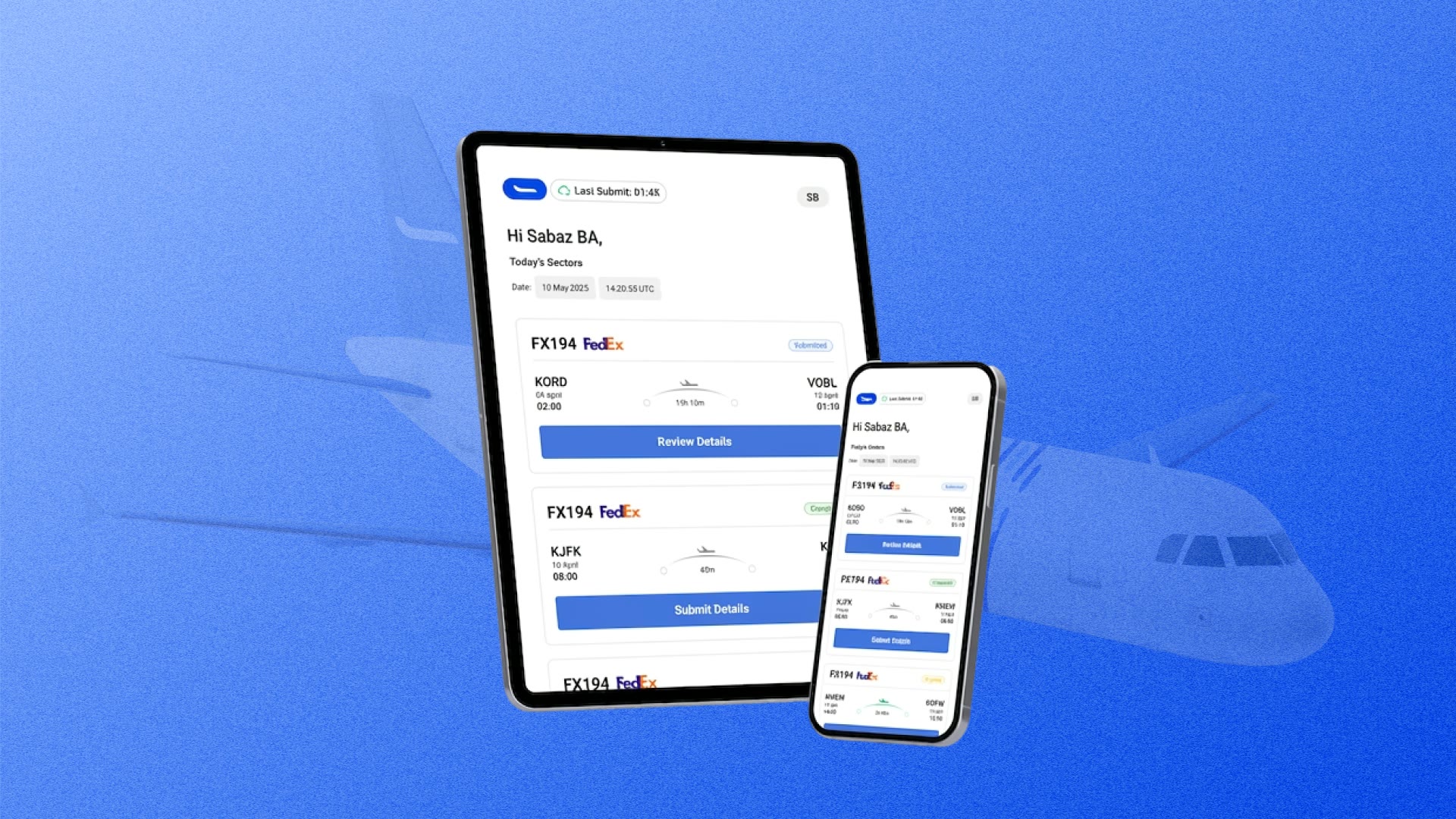
Externo was brought in to build the digital replacement: a tablet application, mounted in the aircraft itself, designed for gloved hands, poor lighting and the pressure of a turnaround window. Rather than reproduce a paper form on a screen, we designed an interaction model that moves through the required entries quickly and cleanly.
On top of the app we designed and built an AI layer that removes most of the manual entry altogether. The crew can speak the values, or scan the instrument panel and the existing log book, and the corresponding fields populate themselves — leaving them to verify and sign rather than transcribe. It was delivered as a full native product on both Android and iOS.
Roughly 126 hand-written fields per flight, turned into a few spoken words and a scan — and a signature at the end instead of a transcription.
02
A hard place to type
A cockpit during a turnaround is one of the least forgiving places to design for. The people using the app are wearing gloves, the light is often poor, and the clock is running — every extra second on paperwork is a second the aircraft isn’t ready. A design that works in a quiet office would fail completely here.
The paperwork itself is unforgiving too. Around 126 fields, spread across the technical and journey log books, each has to be correct — this is regulated aviation, where a transcription slip isn’t a typo, it’s a compliance and safety issue. Simply digitising the form would have kept all of that manual burden, and its error risk, fully intact.
So the brief was twofold: replace the paper without slowing the crew down, and then go further — remove as much manual entry as possible without ever compromising the accuracy the log books demand. The app had to be faster than a pen and more reliable than a tired hand at the end of a long day.
03
Built for gloves and glare
We designed the interaction model around the reality of the cockpit rather than the structure of the form. Entries were grouped and ordered by how a crew actually works through a pre-flight and post-flight check, the touch targets were sized for gloved hands, and the interface was built to stay legible in poor light and readable at a glance under time pressure.
In parallel, we designed and built the AI layer that does the heavy lifting — and treated it as a way to remove work, not add features. A few principles guided the build:
- Designed for gloved hands, poor light and a running clock
- Move through entries the way a crew works, not the way the form is laid out
- Speak or scan to fill — typing is the fallback, not the default
- The crew verifies and signs; the app does the transcription
- Accuracy first — nothing ships that risks a wrong value in a log book
- One native product, consistent across Android and iOS
04
Speak it or scan it
The result is a native tablet application, mounted in the aircraft and published on both Android and iOS, that turns a long manual ritual into a quick, verifiable one. Instead of writing out roughly 126 fields by hand, the pilot or engineer speaks the values, or scans the instrument panel and the existing log book, and the app fills the corresponding entries in.
That shifts the crew’s job from transcription to verification — reading back what the app captured, correcting anything that needs it, and signing off. The full delivery:
- A cockpit-mounted tablet app replacing ~126 hand-written fields per flight
- Native builds published on both Android and iOS
- Voice entry — speak the values instead of writing them
- Scanning of the instrument panel and existing log books
- An interaction model built for the turnaround, not a paper form on glass
- A verify-and-sign flow in place of manual transcription
05
Verify, don't transcribe
Jetlog replaced a slow, error-prone paper process with a fast digital one that crews can trust, and the client is now building further on that foundation, extending the platform across their operation. Rather than a set of numbers, the meaningful outcome is a changed way of working:
- Around 126 hand-written fields per flight replaced by speak-and-scan entry
- Transcription turned into a quick verify-and-sign
- Designed for real cockpit conditions — gloves, glare and time pressure
- A full native product live on both Android and iOS
- Transcription-error risk designed out of the daily process
- A foundation the client is actively extending across its operation
06
A foundation to build on
Jetlog set out to take one of aviation’s most repetitive manual tasks off pen and paper, and the app does exactly that — without asking the crew to slow down or trust the process less. The paperwork that used to bracket every flight is now a few spoken words, a scan and a signature.
What made it work was designing for the cockpit as it really is, and treating the AI layer as a way to remove effort rather than show it off. The crew stays in control — they verify and sign — while the app absorbs the tedious, error-prone part.
The client is already building on this foundation, extending the platform further across their operation. What they hold is not a one-off tool but a base designed to grow — a faster, safer way to keep the records that regulated aviation runs on.


 The result in motion