01
From paper to live
EMQIM is an aviation engineering and maintenance client based in Bangalore whose operations depended almost entirely on paper. Every aircraft carried its own technical log book, every sector generated its own set of records, and every question from management required someone to physically go and find the answer.
We were brought in to turn that scattered operational reality into a single, live source of truth. We designed the data architecture from the ground up, mapping how flight movements, crew and passenger counts, on-board equipment, engineering tasks and assigned mechanics all relate to one another.
On top of that model we built a secure web dashboard that answers the questions stakeholders actually ask: how many aircraft are flying today, who is on board, what equipment has gone out, which engineers are handling which jobs, and where each maintenance activity currently stands.
What was a reactive, log-book-driven process is now a monitored operation that can be reviewed in seconds rather than reconstructed over days.
02
A log-book operation
Paper works right up until you need to ask a question across it. With each aircraft carrying its own technical log book and every sector producing its own records, the state of the operation was real but scattered — true somewhere, findable nowhere quickly.
That made the whole operation reactive. A simple management question could not be answered from a screen; it had to be reconstructed by walking to the aircraft, pulling the book, and reading it. Over a fleet, over days, that cost is enormous and the picture is always slightly out of date.
The brief was demanding precisely because aviation records are unforgiving: the system had to capture the same detail the log books held, relate it correctly, and expose it securely to the right people — without losing any of the rigour the paper process enforced.
03
One data model
We started with the architecture rather than the interface. We mapped how flight movements, crew and passenger counts, on-board equipment, engineering tasks and assigned mechanics relate to one another, so that a single connected model could answer questions the log books never could on their own.
The platform was then built in pure Java with credential-based, role-specific access. Leadership, engineering and operations each see exactly the slice of data relevant to them, from any location, with the dashboard surfacing live answers rather than raw records.
A few principles kept the work honest:
- A ground-up data model relating every operational entity
- Flight movements, crew, equipment, tasks and mechanics linked
- Built in pure Java for a durable, self-contained platform
- Credential-based, role-specific access throughout
- Answers surfaced live, not reconstructed from records
- Accessible securely from any location
04
Answers in seconds
The result is a secure web dashboard that answers the operational questions leadership actually asks. How many aircraft are flying today, who is on board, what equipment has gone out, which engineers are on which jobs, and where each maintenance activity stands — all visible at a glance.
Because access is role-specific, each group sees the view that matters to them without wading through the rest. The same underlying model serves the principal’s overview and the engineer’s task list, so everyone is reading from one consistent picture.
What we shipped, in one platform:
- A live operations dashboard over a unified data model
- Real-time fleet status: what is flying and who is aboard
- Equipment, engineering task and mechanic assignment tracking
- Role-based views for leadership, engineering and operations
- Secure, credential-based access from any location
- A pure-Java build with no external platform dependency
05
What the dashboard changed
A process that used to be reconstructed over days can now be reviewed in seconds. The manual effort of walking to aircraft and reading log books to answer a management question has been replaced by a live view that is always current.
For EMQIM, the operation shifted from reactive to monitored:
- Paper log books replaced by a single live source of truth
- Management questions answered in seconds, not days
- Fleet, crew, equipment and maintenance visible at a glance
- Each role served exactly the data relevant to it
- Operational status current rather than reconstructed
- A reactive process turned into a monitored one
06
A monitored operation
EMQIM turns a scattered, paper-bound reality into a single system leadership can trust. Because every entity is related in one model, the questions that used to take days now resolve the moment they are asked.
The pure-Java build and role-based access give the platform the rigour aviation demands, while keeping it self-contained and secure — the discipline of the log book, without its friction.
What was previously reconstructed after the fact is now watched as it happens, giving the business a monitored operation it can review in seconds and act on with confidence.


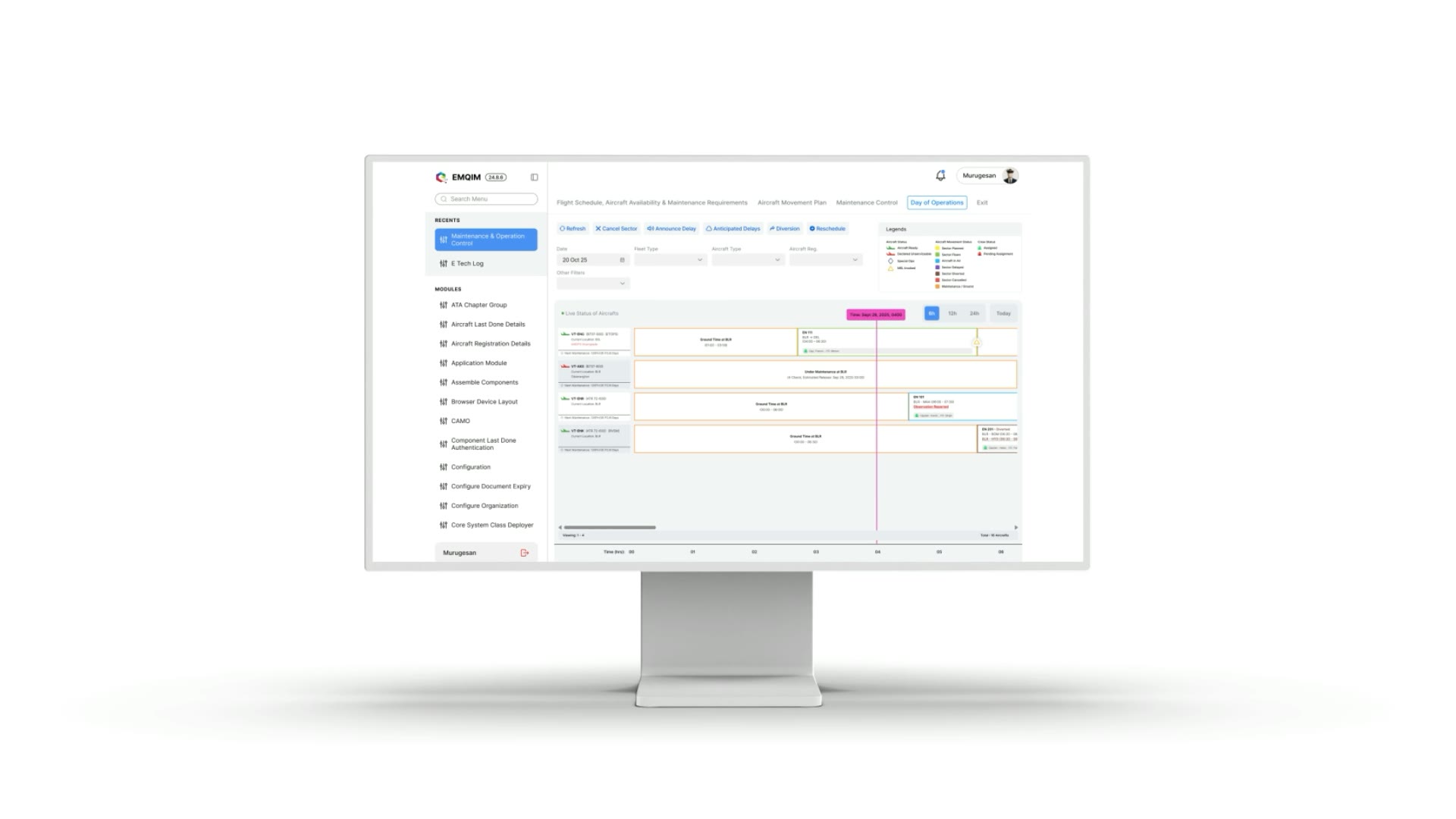
 The result in motion